Bachelor of Engineering Program in Civil Engineering (2566)
Program Overview
The Bachelor of Engineering in Civil Engineering program is the first undergraduate program of the Faculty of Engineering, Chiang Mai University. It was first offered in 1970 (B.E. 2513). This program encourages students to develop their civil engineering abilities to the fullest according to their potential and interests, while taking into account the needs of employers and society.
The program’s philosophy reflects this by offering students the opportunity to choose elective courses in specific subfields of civil engineering that align with the demands of the job market and society. These electives can be selected based on the students’ aptitudes and interests, in addition to the compulsory courses required by the Council of Engineers. The program also provides a solid foundation for further study at the postgraduate level.
-
The program includes two optional tracks:
-
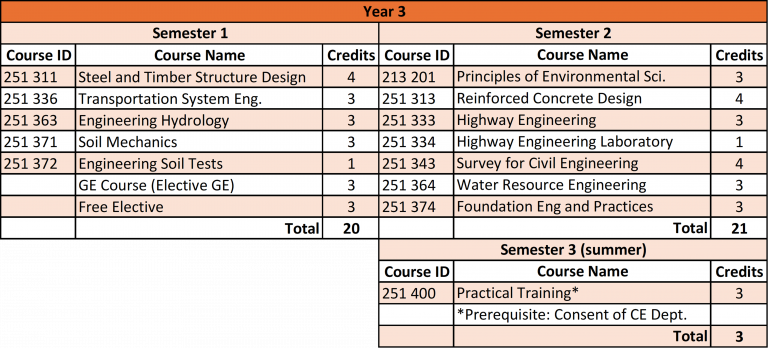
- Regular practical training track: students practice with professional civil engineering or construction company or government agencies for two months during the summer semester of the third year of study. For superior performance students, with grade point average of 3.50 or more, they can choose to study master’s level courses in the places of regular major elective courses.
- Cooperative education track: students practice with professional civil engineering or construction company or government agencies for four months during the first semester of the fourth year of study.
Both tracks require nearly identical coursework except only the regular track requires three civil engineering elective classes whilst the cooperative track requires only two civil engineering elective classes.
Program Educational Objectives (PEO)
The objectives and learning outcomes of this program are to produce bachelor’s degree graduates with the following characteristics:
- Capable of performing all professional engineering tasks in the field of civil engineering as defined by relevant laws.
- Ethical engineers with responsibility for their work and its societal impact.
- Recognized engineers in civil engineering by agencies or organizations in the profession.
- Engineers who contribute to solving national issues related to civil engineering, such as safe and environmentally friendly construction, transportation, water resource management, natural disaster prevention (e.g., floods, landslides, earthquakes), and the preservation of national architecture.
- Engineers capable of self-development in professional knowledge, including pursuing higher education or self-learning.
Student Outcome (SO)
The program’s educational objectives can be achieved through the development of technical and professional skills defined based on ABET student outcomes. From 2020 onwards, ABET student outcomes are used for the program assessment.
|
ABET Student Outcomes |
|
SO-1 An ability to identify, formulate, and solve complex engineering problems by applying principles of engineering, sciences, and mathematics. |
|
SO-2 An ability to apply engineering design to produce solutions that meet specified needs with consideration of public health, safety, and welfare, as well as global, cultural, social, environmental, and economic factors. |
|
SO-3 An ability to communication effectively with a range of audiences. |
|
SO-4 An ability to recognize ethical and professional responsibilities in engineering situations and make informed judgments, which must consider the impact of engineering solutions in global, economics, environmental, and societal contexts. |
|
SO-5 An ability to function effectively on a team whose members together provide leadership, create a collaborative and inclusive environment, establish goals plan tasks, and meet objectives. |
|
SO-6 An ability to develop and conduct appropriate experimentation, analyze, and interpret data, and use engineering judgment to draw conclusions. |
|
SO-7 An ability to acquire and apply new knowledge as needed, using appropriate learning strategies. |
Curricular Area
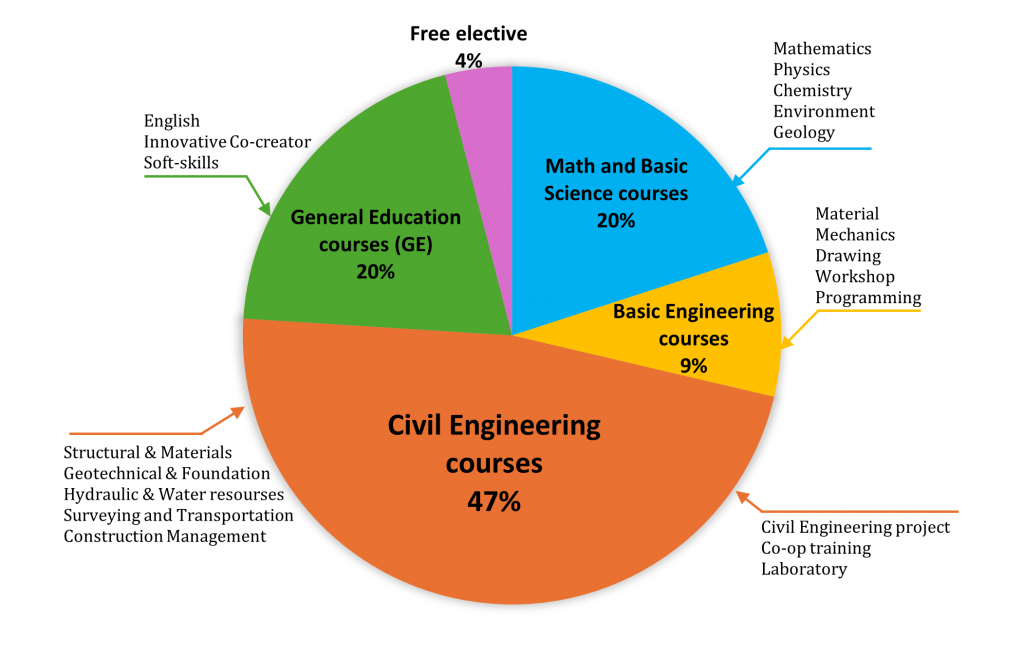
Updated curriculum applied since academic year 2023.
- Math and Basic Science courses: 30 Credits (20%)
- Basic Engineering courses: 13 Credits (9%)
- Civil Engineering courses: 71 Credits (47%)
- General Education courses (GE): 30 Credits (20%)
- Free elective: 6 Credits (4%)
Total: 150 Credits (100%)
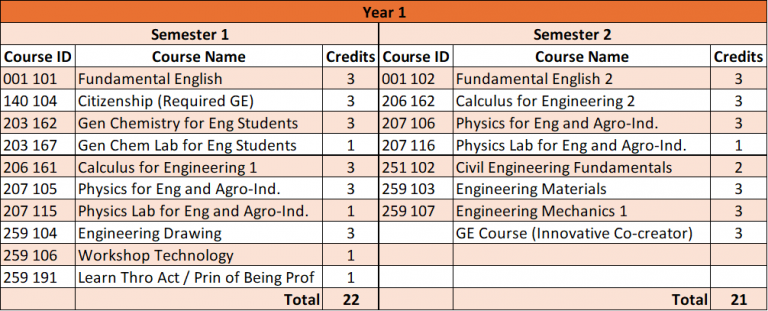
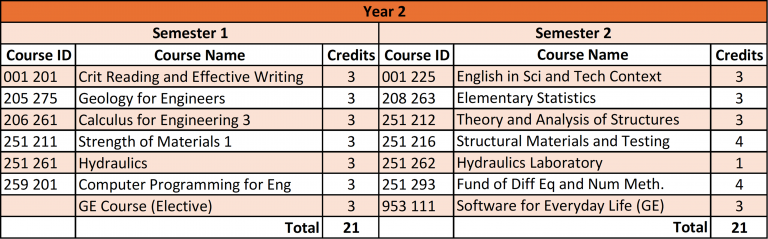
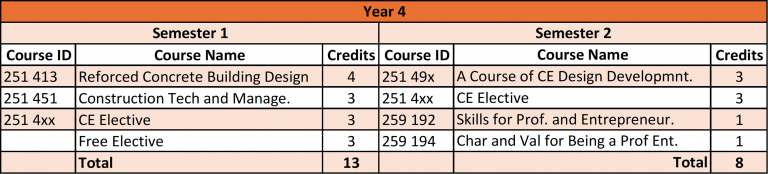
Study Plan (4 years)
Enrolled Students
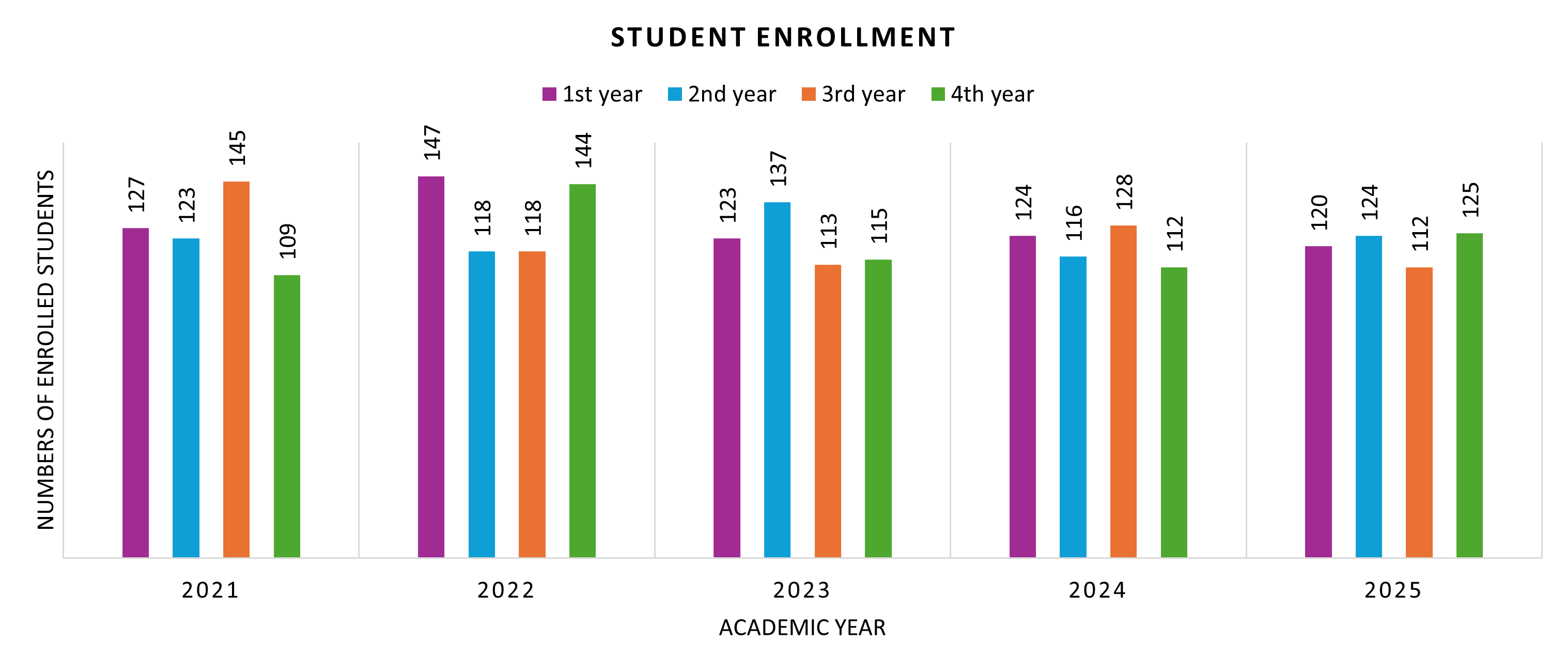
Currently, there are more than 500 students enrolled in the program.
Graduates
Admission
Qualifications of Applicants
-
- Graduated from high school or equivalent.
Admission Process
-
- Student admission is based on Thai University Central Admission System (TCAS).
Number of Admitted Students
-
- 120 students per year.
More information
For more information, please contact the Office of Civil Engineering Department.
Address: Department of Civil Engineering,
Faculty of Engineering, Chiang Mai University
Suthep Sub-district, Mueang Chiang Mai District,
Chiang Mai, 50200.
Telephone: (+66) 5394-4159
Fax: (+66) 5389-2376